
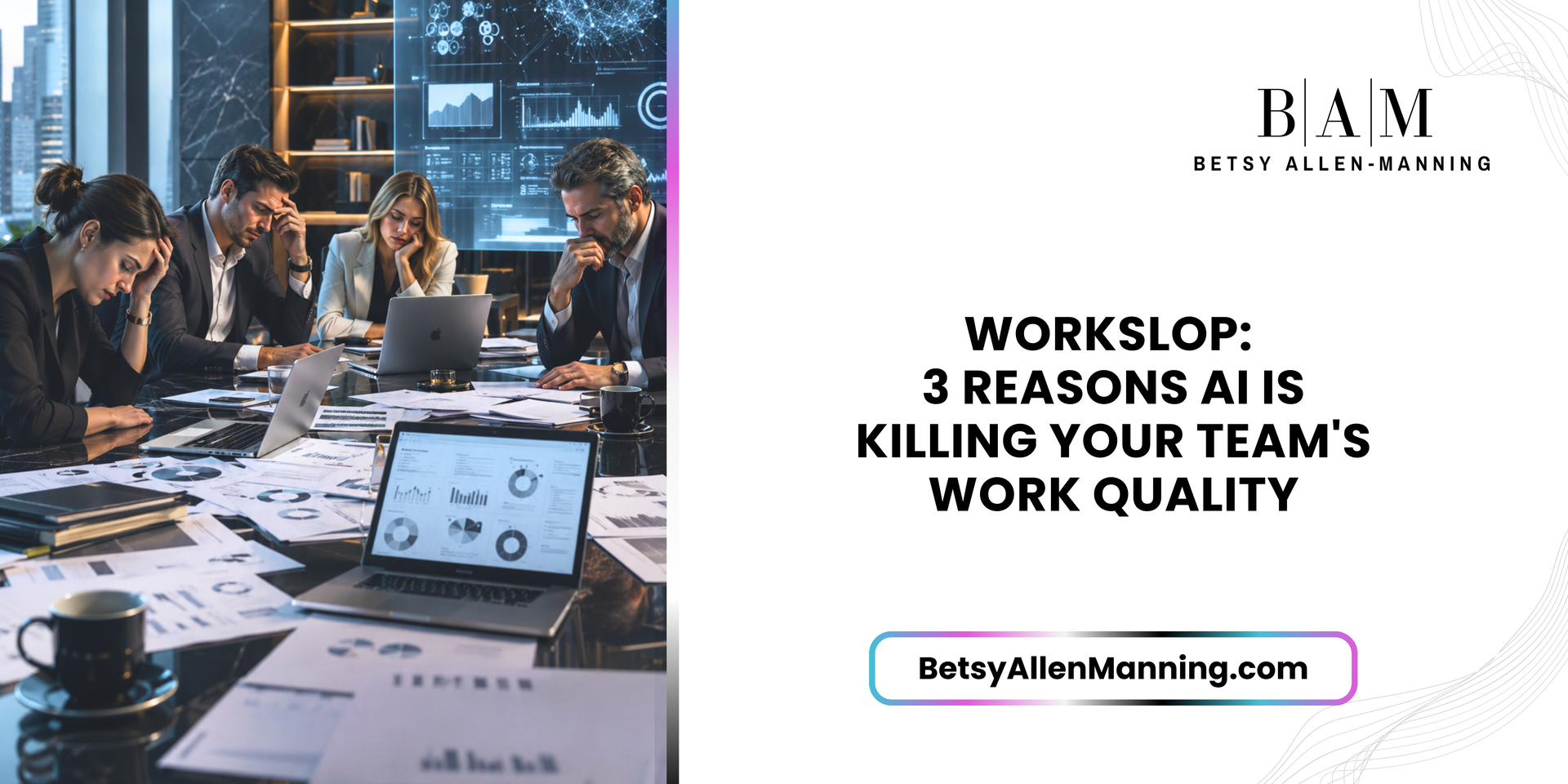
Workslop: 3 Reasons AI Is Killing Your Team's Work Quality
There’s a new word making the rounds in offices, and if you have not heard it yet, you have definitely received it. It’s called “workslop.” It’s the report, the deck, the email that looks polished and professional on the surface and falls apart the second you actually read it. Researchers at Stanford and BetterUp gave it the name, and the numbers are ugly. Around 4 in 10 workers say they have gotten workslop in the last month, and every instance eats close to two hours of someone else’s time cleaning it up. Scale that across a company with 500 to 1,000 people, and you are looking at anywhere from $450,000 to nearly a million dollars a year, gone, on cleaning up work that only looked finished.
Most leaders are treating workslop as an AI ‘prompt’ problem. I disagree, and here are 3 research-backed reasons why…
Reason 1: The Critical-Thinking Loss Problem
When we hand our thinking to AI, we stop thinking, and it happens fast. A brand-new study from Carnegie Mellon, Oxford, MIT, and UCLA found that after just ten minutes of leaning on an AI assistant, people were about 20% worse at solving problems once it was taken away, and they gave up on problems twice as often as the people who never used it. Just…ten…minutes!
So how does it lower our critical and creative-thinking skills? AI will only ever work inside the box it was built for. If you want out-of-the-box results, you need an out-of-the-box thinker, and that requires
your brain, not AI’s output. The moment your people outsource the thinking, they stop bringing the one thing that made their work worth anything: their judgment, their research, their point of view.
A few weeks ago, I had AI draft an article for me. And honestly? The bones were there. It was fine. It was “done.” But my deep research wasn’t in it. My personality wasn’t in it. My actual insights, the stuff people pay me for, weren’t in it. So I spent hours putting them back. AI gave my article a skeleton, but it could not give it a soul. That’s the trap with workslop. It looks done.
But ‘done’ isn’t how Bar Raisers™ operate. ‘Done with excellence’ is.
Reason 2: The Sameness Problem
Critical thinking loss is what AI does to the thinker. This is what it does to the work. It makes everyone's work the same. Think about it. Your team, your competitor's team, and a stranger three time zones away are all prompting their AI tools to provide the same output. The receiver gets the same structure, same phrasing, and the same ‘em-dash-filled’ result. It looks clean. It also looks like everyone else's. Originality disappears, and your team starts producing average work, and unfortunately, ‘average’ tends to be forgettable, and unlike Bar Raisers™, average is a Tolerator trait.
Researchers measuring idea diversity found that human-written essays contributed roughly two to eight times more original ideas compared to the AI-generated ones. And a big creativity study out of
UCL and Exeter found that AI-assisted stories were rated more polished individually, but were near copies of each other. Better-looking, more alike, less original.
Done is not the goal of a Bar Raiser™. Done with excellence is.
Reason 3: The Trust Tax
Workslop doesn't just cost time; it costs reputation, and that's the more expensive bill. When someone hands you sloppy AI work, you don't blame the tool. You blame them. You quietly downgrade them in your head, and you never tell them you did it.
The numbers here are rough. In that same workslop study, over half the people who received it said they saw the sender as less capable and less reliable, 42% trusted them less, and 37% walked away thinking the person was less intelligent. One rushed, AI-padded report, and that's the tax, except you never see the bill. You just notice people stop looping you in, or using your services.
Trust is the foundation of a Destination Workplace®. It's what makes people cover for each other and speak up when something's off. And slop cancels it. Not in one dramatic blowup, but a dollar at a time, one "good enough" file after another, until the account is empty and nobody can tell you when it happened. A Tolerator isn't trying to burn trust. They're just comfortable, and comfortable feels harmless right up until your reputation is ruined.
What to do Monday morning
AI didn't give us ‘workslop’. We brought it on the second we started accepting "good enough" as the final product. That's a Tolerator's bar, and a bar is the one thing a leader can always raise. Here's where to start Monday morning…
You don't need to ban AI. You need to out-think it. Bar Raisers™ raise the bar on what counts as ‘done’.
👉On Monday, hand your team one rule for anything AI helped create. Before it leaves their hands, they answer a single question out loud: "What did I add that the AI couldn't?"
If they can name something real they brought to it, it's done. If the honest answer is "nothing, but it looks good," it's not done. Send it back.
Treat AI like the fastest intern you have ever hired. Brilliant, tireless, and completely missing your context and the fact that it is your name on the line. You would never forward an intern's rough first draft to a client untouched and call it a day. Stop doing it with a chatbot.
That one question drags the thinking back into the room, because nobody answers it on autopilot. It forces your people's real voice back into the work. And the trust that every "good enough" file was draining stops leaking, because slop never gets out the door.
That is what a Bar Raiser™ does with AI. They let it prompt the skeleton, but they refuse to send anything without a soul.
About Betsy:
Betsy Allen-Manning is the wake-up call you didn’t know you needed. She’s a high-energy leadership keynote speaker and creator of the Bar Raisers™ Movement: a proprietary system redefining how organizations are approaching performance, leadership, and culture. Featured on FOX, CBS, NBC, ABC, and TEDx, Betsy works with organizations across corporate, franchise, association, nonprofit, and government sectors. She’s the lead researcher behind the National Workplace Trends Study, and delivers programs around her Bar Raisers™ and Leadership Mastery frameworks. She is the founder of Destination Workplace®, an award-winning leadership development firm in Dallas, Texas.
If “whatever the AI spit out” has quietly become your team’s standard, your competitors will pass you while your people stop thinking. I help organizations build cultures of Contagious Excellence, where Bar Raisers™ refuse to hand in less than their best, with or without AI. Let’s talk about bringing a Bar Raisers™ keynote to your next event.