
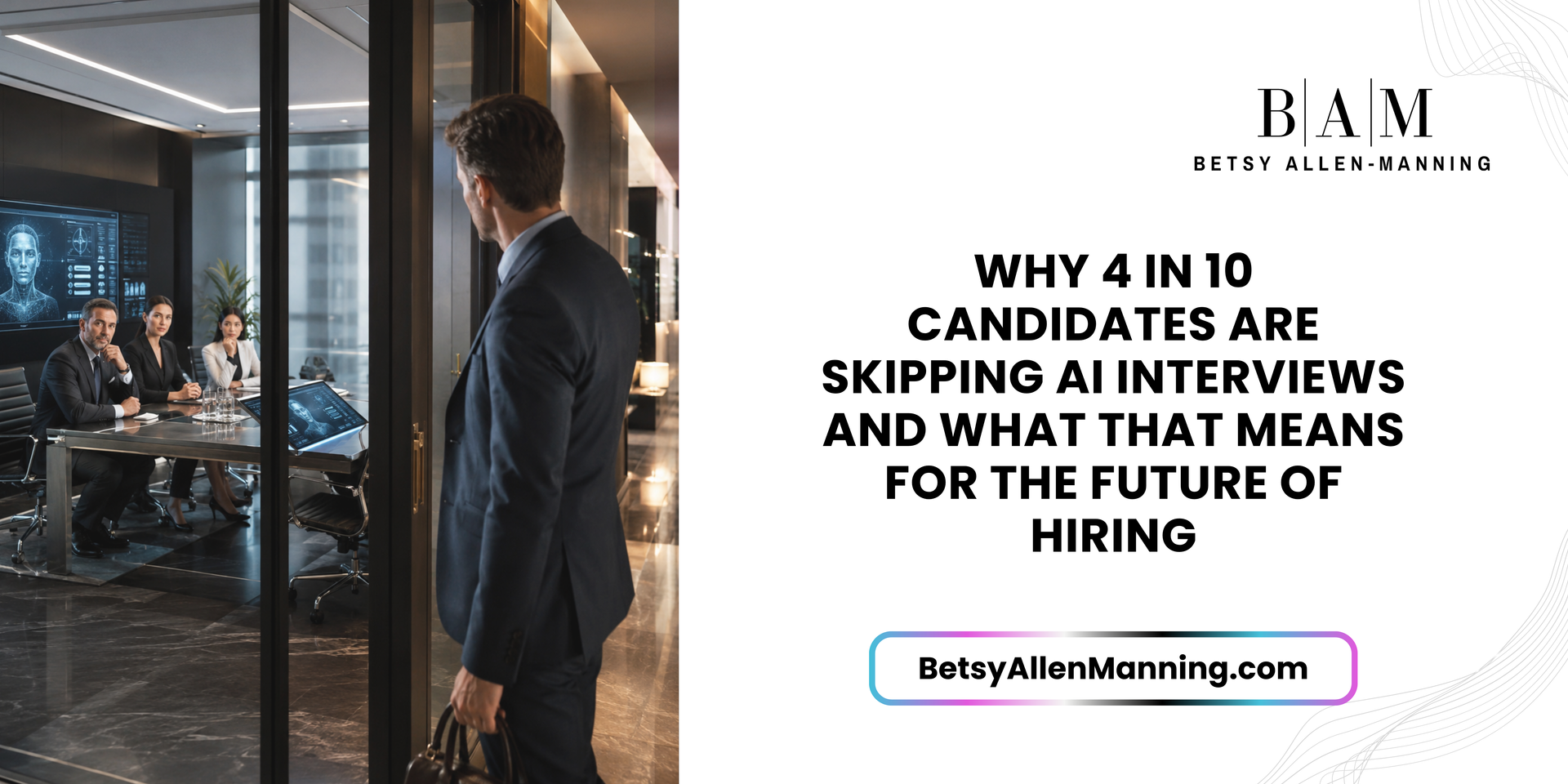
Why 4 in 10 Candidates Are Skipping AI Interviews And What That Means for the Future of Hiring
Companies are moving fast to automate hiring. Candidates are moving just as fast to opt out of it.
According to a recent Fortune report, nearly 4 in 10 candidates have withdrawn from a hiring process because it required an AI interview. That should concern leaders, not because AI is inherently bad, but because many organizations are confusing hiring efficiency with human connection. And those are not the same thing.
The companies winning the future of hiring will not be the ones using the most AI. They will be the ones who know how to use technology without stripping the humanity out of the candidate experience.
Because your hiring process is not just a recruiting function anymore. It is a culture demonstration.
Are AI Interviews Hurting the Candidate Experience?
The short answer is yes, when companies implement them poorly.
AI can absolutely improve parts of the hiring process. It can speed up scheduling, reduce administrative overload, improve communication timelines, and help recruiters manage larger applicant pools more effectively.
But candidates are not looking for a fully automated experience. They are looking for signals.
✅
Signals that the company values people.
✅
Signals that leadership cares.
✅
Signals that they will be treated like a human being instead of a data point.
When candidates are asked to record answers into a screen with little explanation, limited interaction, and no relationship-building, many walk away feeling processed instead of pursued. And perception matters.
As we continue to see through the National Workplace Trends Study, the employee experience directly impacts attraction, engagement, and retention. The hiring process is simply the first stage of that employee experience. And as we always say at Destination Workplace®….
Words don’t define your culture; employee experiences do.
Why Are Candidates Pulling Out of AI Interviews?
For many candidates, the concern is not the technology itself. It is the uncertainty surrounding it.
They are asking questions like:
How Is AI Evaluating Me?
Many candidates are unsure whether AI systems are analyzing facial expressions, tone of voice, eye contact, or communication patterns. That uncertainty creates hesitation. Especially in a workforce already navigating burnout, layoffs, instability, and increasing distrust in workplace systems.
Is There Even a Real Person Involved?
Candidates want to know whether a leader or recruiter is actually reviewing their responses. Without that reassurance, the process can feel impersonal and disconnected. And in today’s workforce, disconnected experiences create disengaged people.
Does Automation Signal a Cold Culture?
Here is the bigger issue many companies are missing. Candidates often interpret the hiring experience as a preview of the workplace culture itself. If the interview process feels robotic, transactional, or emotionally detached, they assume leadership operates the same way internally. Whether that assumption is accurate or not almost becomes irrelevant. The perception becomes the reality.
Should Candidates Avoid AI Interviews?
Not necessarily. In fact, adaptable candidates may gain an advantage moving forward.
Every workforce shift creates two groups of people:
Those who resist the change. (We call them Tolerators)
And those who learn how to navigate it wisely. (We call them
Bar Raisers™)
The workforce has evolved before, and it will evolve again. The professionals who remain valuable are the ones willing to strengthen their communication skills, confidence, and adaptability instead of retreating from every uncomfortable shift.
Candidates preparing for AI interviews should focus on:
- concise communication
- confidence on camera
- storytelling ability
- reduced filler words
- eye contact and energy
- communicating value clearly and quickly
Whether someone is speaking to a recruiter or an AI platform, communication still matters. Presence still matters. Preparation still matters.
What Will the Future of Hiring Require From Leaders?
The future of hiring will belong to organizations that humanize technology. Not organizations that eliminate people from the process entirely.
The strongest companies moving forward will learn how to combine:
- efficiency with empathy
- automation with authentic leadership
- technology with trust
Because people still want to work for people.
And leadership teams need to remember something important:
Just because something can be automated does not mean the human element should disappear.
If companies want to attract the best talent in their industry, they need to commit to being the best experience in their industry. That starts long before day one.
FAQ
Are AI interviews becoming more common?
Yes. More organizations are using AI throughout the hiring process to improve speed, scheduling, screening, and scalability.
Why are candidates uncomfortable with AI interviews?
Many candidates feel uncertain about how they are being evaluated and worry the process lacks human connection and fairness.
What should companies focus on when using AI in hiring?
Companies should use AI to support efficiency while still preserving human interaction, trust, transparency, and relationship-building throughout the hiring process.
About Betsy:
Betsy Allen-Manning is the wake-up call you didn’t know you needed. She’s a high-energy leadership keynote speaker and creator of the Bar Raisers™ Movement: a proprietary system redefining how organizations are approaching performance, leadership, and culture. Featured on FOX, CBS, NBC, ABC, and TEDx, Betsy works with organizations across corporate, franchise, association, nonprofit, and government sectors. She’s the lead researcher behind the National Workplace Trends Study, and delivers programs around her Bar Raisers™ and Leadership Mastery frameworks. She is the founder of Destination Workplace®, an award-winning leadership development firm in Dallas, Texas.